
UVFS Simple Telescope Kit
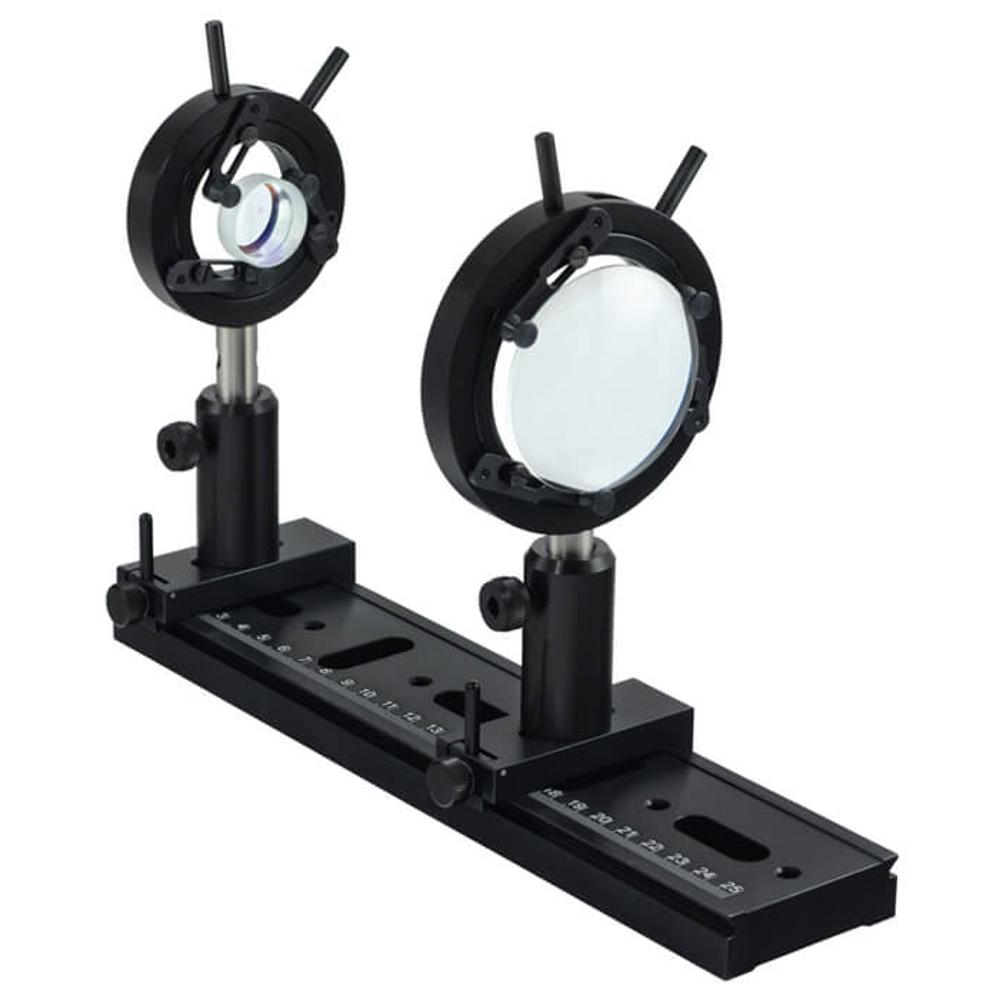
Simple lenses are subject to optical aberrations. In many cases these aberrations can be compensated for to a great extent by using a combination of simple lenses with complementary aberrations. A compound lens is a… Read more →
Volume discount
- 5–9 units −5%
- 10+ units −10%
Applied in your cart. Quantities of any variant of this product count together.
Listed in
Configure & order — pick a catalog variant or configure your own
| SKU | Coating · Material · Note | |
|---|---|---|
| 140-1008 | uncoated·UVFS·Any other antireflection coating wavelength region is available on request. |
Out of stock
$1,404
|
| 141-1008 | 532 nm + 1064 nm, R<0.5%·UVFS·Any other antireflection coating wavelength region is available on request. |
Out of stock
$1,782
|
| 143-1008 | 355 nm, R<0.25%·UVFS |
Out of stock
$1,758
|
| 144-1008 | 266 nm, R·UVFS |
Out of stock
$1,764
|
| 145-1008 | 350-900 nm, R<1.5%·UVFS·Any other antireflection coating wavelength region is available on request. |
Out of stock
$2,022
|
| 146-1008 | 210-400 nm, R<1.5%·UVFS·Any other antireflection coating wavelength region is available on request. |
Out of stock
$2,016
|
| 148-1008 | 650-950 nm, R·UVFS |
Out of stock
$1,974
|
| 149-1008 | 266 nm + 355 nm, R<0.6%·UVFS |
Out of stock
$1,776
|
We can make this for you
No catalog variant matches your exact spec. Add it to your cart as a custom item — sales will confirm price and lead time within 1 business day.
Specifications
| Lens 1 | Focal / length f₁, mm | Lens 2 | Focal length / f₂, mm | Distance between / lenses d=F₁+F₂, mm | Magnification, M |
|---|---|---|---|---|---|
| UVFS bi / cv Ø12.7mm | UVFS pl / cx Ø50.8mm | ||||
| 114-1104 | -12.7 | 110-1505 | +75 | 62 | 5.9 |
| 110-1509 | +100 | 87 | 7.7 | ||
| 110-1511 | +150 | 137 | 11.8 | ||
| 110-1515 | +200 | 187 | 15.7 | ||
| 110-1517 | +250 | 237 | 19.7 | ||
| UVFS bi / cv Ø25.4mm | UVFS pl / cx Ø50.8mm | ||||
| 114-1204 | -25 | 110-1505 | +75 | 50 | 3 |
| 110-1509 | +100 | 75 | 4 | ||
| 110-1511 | +150 | 125 | 6 | ||
| 110-1515 | +200 | 175 | 8 | ||
| 110-1517 | +250 | 225 | 10 | ||
| UVFS pl / cv Ø25.4mm | UVFS pl / cx Ø50.8mm | ||||
| 112-1205 | -50 | 110-1505 | +75 | 25 | 1.5 |
| 110-1509 | +100 | 50 | 2 | ||
| 110-1511 | +150 | 100 | 3 | ||
| 110-1515 | +200 | 150 | 4 | ||
| 110-1517 | +250 | 200 | 5 |
Description
Simple lenses are subject to optical aberrations. In many cases these aberrations can be compensated for to a great extent by using a combination of simple lenses with complementary aberrations. A compound lens is a collection of simple lenses of different shapes and made of materials of different refractive indices, arranged one after the other with a common axis.
If two thin lenses are separated in air by some distance d (where d is smaller than the focal length of the first lens), the focal length for the combined system is given by
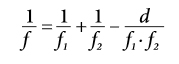
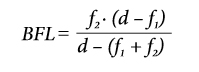
The distance from the second lens to the focal point of the combined lenses is called the back focal length (BFL). If the separation distance is equal to the sum of the focal lengths (d = f1 + f2), the combined focal length and BFL are infinite.
If the separation distance is equal to the sum of the focal lengths (d=f₁+f₂), the combined focal length and BFL are infinite. This corresponds to a pair of lenses that transform a parallel (collimated) beam into another collimated beam. This type of system is called an afocal system, since it produces no net convergence or divergence of the beam. Two lenses at this separation form the simplest type of optical telescope. Although the system does not alter the divergence of a collimated beam, it does alter the width of the beam. The magnification of such a telescope is given by
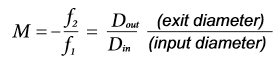
which is the ratio of the input beam width to the output beam width. Note the sign convention: a telescope with two convex lenses (f1 > 0, f2 > 0) produces a negative magnification, indicating an inverted image. A concave plus a convex lens (f1 < 0 < f2) produces a positive magnification and the image is upright.