
HR coating development on Er:YAG laser crystals
Reliable HR coatings for Er:YAG are not a matter of picking a specific material or process step, but of getting the combination right. TiO2/SiO2 remains the preferred material system: its index contrast keeps layer counts low, and its durability suits real-world handling. In EKSMA Optics' experience, e-beam coating with IAD, rather than IBS, is what makes that material system viable at 2940 nm specifically, by controlling the OH- incorporation that would otherwise degrade the transparency the design depends on.
1. Introduction
Erbium-doped yttrium aluminum garnet (Er:YAG) lasers fill a specific niche in solid-state lasers, emitting at 2940 nm, a wavelength that almost exactly matches a strong absorption band of water. This wavelength specificity is the reason Er:YAG has become one of the dominant gain media for medical and dental applications requiring precise, minimally damaging tissue ablation, and it has driven a growing wave of industrial applications in materials processing where controlled interaction with hydroxyl-bearing or hydrated materials is required.
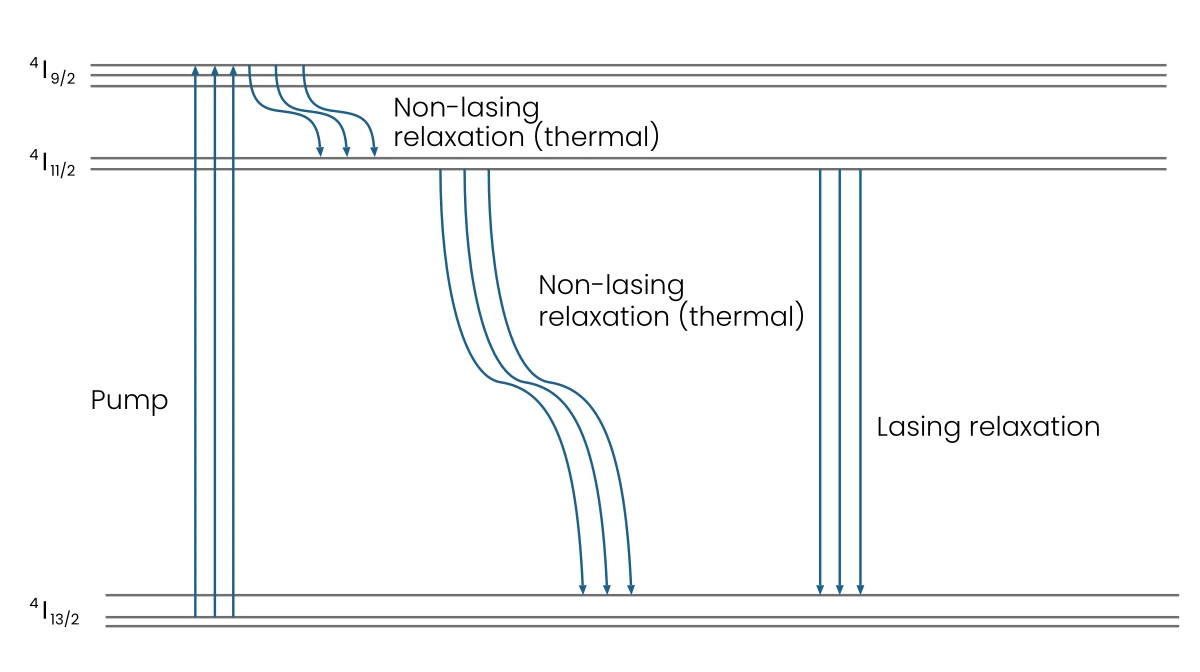
What distinguishes Er:YAG from more commonly discussed active media such as Nd:YAG is not just its wavelength, but the key physics involved. The 4I11/2 → 4I13/2 transition (as seen in Figure 1) responsible for lasing is self-terminating: the lower laser level (4I13/2) is far longer-lived than the upper level (2 ms against 0.1 ms), so population builds up in the lower level and inversion can only be sustained with high erbium doping and a comparatively high pump threshold.[1] This has a direct and often overlooked consequence for resonator design: cavity losses that would be tolerable in a four-level system become disproportionately costly here, since any parasitic absorption or scatter at the lasing wavelength compounds directly with the already limited inversion of the gain medium.
High-reflectivity coatings are therefore not a peripheral component of an Er:YAG laser system but one of the primary factors keeping the lasing threshold and efficiency within a viable operating range. Yet the coating technology built up over decades (like IBS) for near-infrared systems does not transfer cleanly to 2.94 µm. The same oxide materials and deposition approaches that yield excellent, durable HR mirrors at 1 µm begin to show their limits when reaching this wavelength. This whitepaper examines why that gap exists and what it implies for how HR coatings on Er:YAG optics should be designed and produced.
2. Why the 2.94 µm band breaks conventional coating design
The main dielectric oxide materials that are used for near-infrared HR coatings are SiO2 paired with Ta2O5 or HfO2. These dielectrics owe their popularity to a favorable combination of high refractive index contrast, mechanical durability, and low absorption across the visible and near-IR. But these parameters do not extend to mid-IR requirements. Two main effects come into play in this spectral region: residual hydroxyl (OH-) groups incorporated during deposition give rise to absorption features that fall directly across the 2.7–3.0 µm range, and these same oxides are approaching the onset of their lattice absorption edge, where the material's own vibrational modes induce absorption regardless of how well the deposition process is controlled.[2] Neither problem can be fully eliminated by process optimization alone; they constrain which oxides and processes are viable.
A second problem is at the process level rather than the material level. Conventional thermal or e-beam evaporation methods tend to produce films with a comparatively porous microstructure, a consequence of how evaporated species arrive at the substrate with limited kinetic energy and self-shadow as they are deposited. The resulting pores absorb atmospheric moisture after deposition, reintroducing OH- content into the film independent of the purity of the source material or the intrinsic absorption of the chosen oxide. A good coating designed on paper with well-chosen low-absorption materials can still underperform at 2.94 µm once the deposited structure takes up ambient humidity.
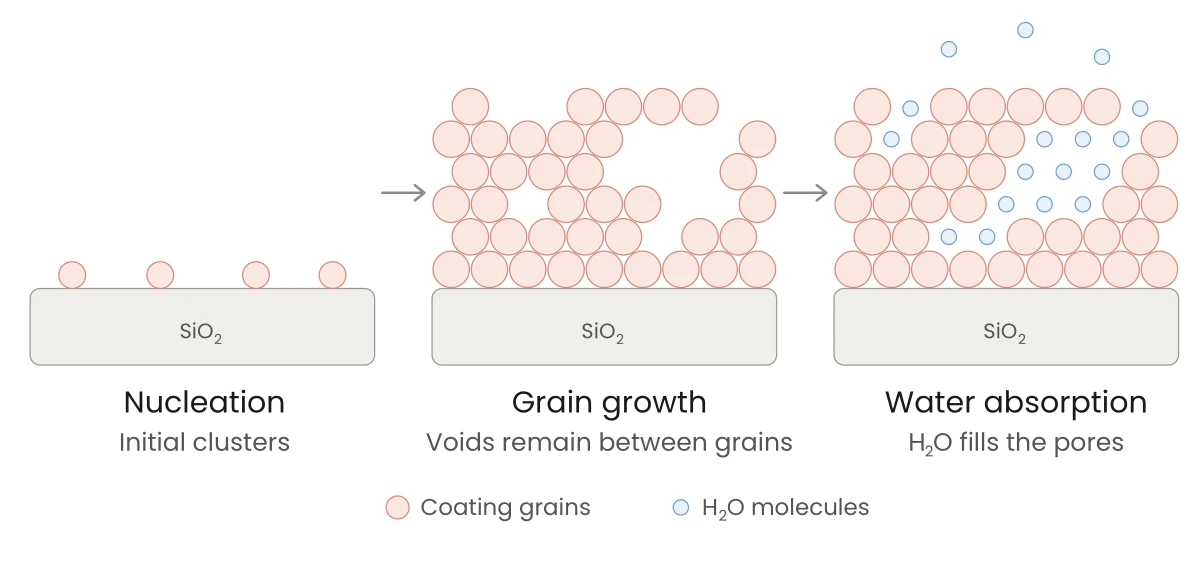
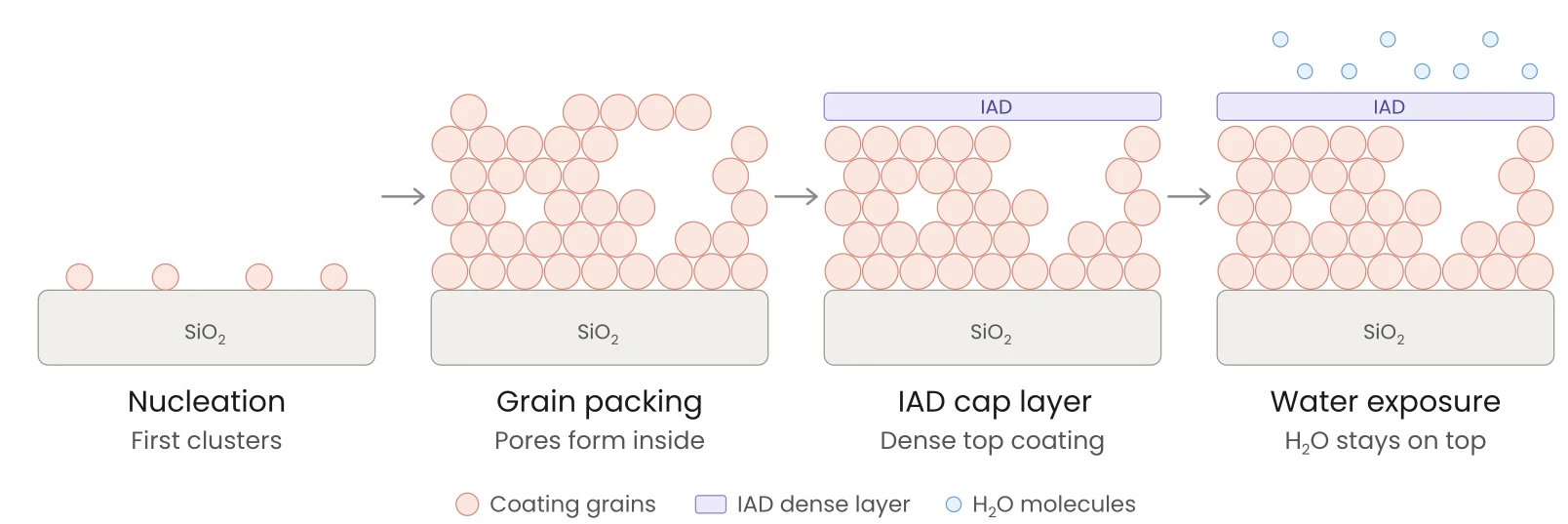
Ion-assisted deposition (IAD) addresses this directly by bombarding the film with an ion flux during the evaporation, densifying the structure as it forms and closing off much of the void network, hence sealing the pores with an atomic hermetic seal. This densification also improves mechanical stability and adhesion.
For a four-level gain medium, a coating with slightly elevated absorption at the lasing wavelength is a tolerable inefficiency: it raises the loss budget, but the laser still operates comfortably above threshold. For Er:YAG's self-terminating transition, the same coating flaw compounds with an already-elevated threshold driven by the long-lived lower laser level. A mirror that shows negligible absorption at 1064 nm can introduce enough parasitic loss at 2940 nm to meaningfully shift threshold, degrade slope efficiency, or in poorly designed cases prevent the cavity from lasing at all. This sensitivity is what makes coating performance at this wavelength a design-critical parameter rather than a secondary specification.
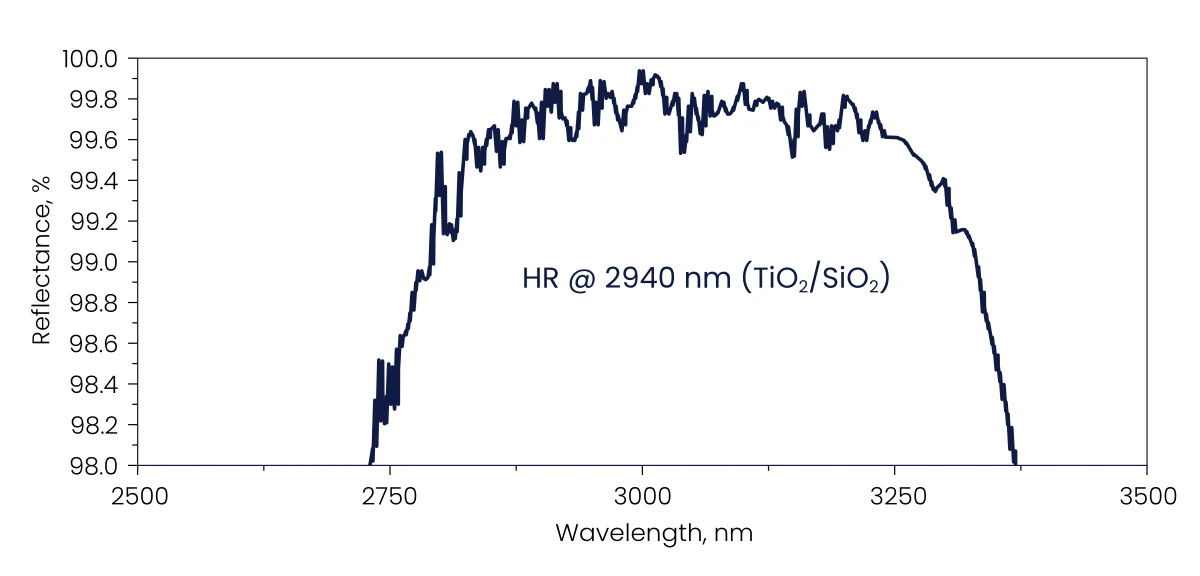
The practical implication is that HR coatings for Er:YAG cannot be treated as a straightforward extension of a proven 1 µm recipe scaled to a longer wavelength. The oxide materials, and in many cases the deposition processes built around them, need to be reconsidered from the material first. This is the gap that titanium oxide coatings deposited by ion-assisted e-beam evaporation aim to close. According to EKSMA Optics experimental results, (depicted in Figure 3) the coating using titanium oxide with IAD does not show any significant reflection losses for the above-mentioned wavelengths.
3. Material selection
Given the absorption concerns in Section 2, it is fair to ask why this design does not simply move to fluoride materials, which are intrinsically more transparent in the mid-IR. Three practical factors keep TiO2/SiO2 as the better choice for most Er:YAG HR designs.
First, index contrast: TiO2 (n ≈ 2.2–2.4) against SiO2 (n ≈ 1.42) is one of the largest practical contrasts among stable oxides, so fewer layers are needed to reach a given reflectivity, and fewer layers means less cumulative absorption and scatter to begin with. Second, durability: TiO2/SiO2 films are hard, adherent, and chemically stable, with a long manufacturing track record, unlike fluorides, which are softer, more hygroscopic, and more difficult to handle. That matters for optics that will be cleaned and handled routinely in medical and industrial use. Third, LIDT: TiO2/SiO2 stacks have well-characterized damage behavior, although the high index of TiO2 comes at the cost of a lower laser damage threshold than HfO2/SiO2 designs.[3] For Er:YAG's typical free-running and long-pulse regimes, where damage is driven mainly by absorption and heating rather than peak field strength, keeping absorption low matters more than the intrinsic threshold of the high-index material.
The remaining piece is the OH--driven absorption penalty from Section 2. This is where IAD does its work, densifying the film enough to suppress moisture uptake[4] and bring TiO2/SiO2 absorption at 2.94 µm down to a practical level. Fluorides stay relevant only for the narrower cases demanding the lowest possible absorption regardless of durability trade-offs; for most Er:YAG designs, TiO2/SiO2 with IAD is the more complete answer.
4. Coating design requirements specific to Er:YAG resonators
Beyond material choice, the coating design itself must account for how Er:YAG cavities are built. Many designs need more than a single-band HR at 2940 nm; pump wavelengths often need to be managed on the same or an adjacent surface, which pushes the design toward dual-band or multi-band stacks rather than a simple quarter-wave mirror.
Angle of incidence and polarization sensitivity are also more consequential than they might first appear. Folded cavities routinely use HR mirrors off normal incidence, and a stack optimized only for 0° AOI can show meaningful reflectivity changes and phase shifts once tilted, a design detail that is easy to overlook until it shows up as unexplained cavity loss.
Finally, layer count itself is a trade-off, not a free variable. The high index contrast of TiO2/SiO2 (Section 3) keeps layer counts low for a given reflectivity target, but pushing toward higher R (e.g., beyond 99.5%) still means adding pairs, and each added pair reintroduces some of the absorption and stress the earlier sections worked to minimize. In practice, this means design targets need to be set against what is required for the application, rather than defaulting to the highest achievable reflectivity.
5. Deposition process considerations
Two deposition routes dominate for TiO2/SiO2 HR stacks: e-beam evaporation with ion-assisted deposition (IAD), and ion beam sputtering (IBS). For most oxide coating applications, IBS is treated as the higher-performance route: denser films, lower scatter, tighter repeatability. At 2.94 µm, that reputation does not hold: in EKSMA Optics' experience, IBS is more prone to OH- incorporation, and the resulting absorption penalty in the 2.7–3.0 µm band works directly against everything the material and design choices in the earlier sections are trying to achieve. In that sense, IBS's usual advantage becomes a liability here rather than a benefit.
E-beam evaporation with IAD is the better fit for this specific wavelength band. IAD still delivers the film densification needed to suppress post-deposition moisture uptake (Section 2), while giving more direct control over the deposition environment (chamber vacuum and residual moisture) that determines how much OH- is built into the film from the start. The result is a process that trades a small amount of the raw density/scatter performance IBS would otherwise offer for lower absorption at 2940 nm, which is the parameter that matters for Er:YAG cavity loss.
Substrate behavior still needs attention regardless of process choice: YAG's hardness and thermal expansion differ from the TiO2/SiO2 stack, so substrate temperature during deposition has to be controlled to get adequate densification without introducing stress-related adhesion issues.
6. Qualification framework: what "development" needs to demonstrate
Confirming that a coating actually delivers what Sections 3–5 argue for requires validating against a few specific criteria, not necessarily with disclosed numbers here, but as the framework any development effort should be measured against. Spectral performance comes first: reflectivity needs to be verified not just at normal incidence and design wavelength, but across the actual bandwidth and angle-of-incidence range the resonator will see (Section 4), since off-normal or off-band performance is where designs quietly underdeliver.
LIDT testing needs to match how Er:YAG lasers operate. Damage threshold standards developed for ns-regime, four-level systems do not transfer cleanly to Er:YAG's typical free-running long-pulse regimes. Testing protocols need to be matched to the pulse durations the coating will actually see in service, not borrowed from unrelated laser systems.
Environmental durability is equally critical: humidity and condensation resistance, adhesion, and thermal cycling all matter more here than in a typical near-IR coating, given the OH- sensitivity already discussed and the routine handling these optics see in medical and industrial deployment. A coating that meets spectral and LIDT targets in a clean lab environment but degrades after realistic handling and storage has not solved the problem this whitepaper is about.
7. Closing thoughts
The picture that emerges across this whitepaper is that reliable HR coatings for Er:YAG are not a matter of picking a specific material or process step, but of getting the combination right. TiO2/SiO2 remains the preferred material system: its index contrast keeps layer counts low, and its durability suits real-world handling. In EKSMA Optics' experience, e-beam coating with IAD, rather than IBS, is what makes that material system viable at 2940 nm specifically, by controlling the OH- incorporation that would otherwise degrade the transparency the design depends on. Layered on top of that, resonator-level design choices (single- vs dual-band, off-normal incidence, where to stop adding pairs) determine whether the coating performs as intended in the finished laser cavity.
Looking ahead, the more productive direction is refining what is already working rather than chasing new materials: tightening IAD process parameters to push OH- content lower still, and better characterizing how the TiO2/SiO2 stack's stress evolves on YAG over a coating's operating lifetime. Fluoride-based designs do show some promise for the narrow set of applications where absorption requirements outweigh durability concerns, but for most Er:YAG HR coatings, the near-term gains lie in optimizing the TiO2/SiO2 and IAD combination already established here.
Tell us your Er:YAG coating spec
Discuss your project with one of our sales engineers.
Er:YAG HR coating FAQ
-
Why are HR coatings so critical in Er:YAG lasers?
A mirror that shows negligible absorption at 1064 nm can introduce enough parasitic loss at 2940 nm to meaningfully shift threshold, degrade slope efficiency, or in poorly designed cases prevent the cavity from lasing at all. This sensitivity is what makes coating performance at this wavelength a design-critical parameter rather than a secondary specification.
-
Why don’t near-infrared HR coatings work at 2.94 µm?
The main dielectric oxide materials that are used for near-infrared HR coatings are SiO2 paired with Ta2O5 or HfO2. Two main effects come into play in this spectral region: residual hydroxyl (OH-) groups incorporated during deposition give rise to absorption features that fall directly across the 2.7–3.0 µm range, and these same oxides are approaching the onset of their lattice absorption edge, where the material's own vibrational modes induce absorption regardless of how well the deposition process is controlled.[2]
-
Why TiO2/SiO2 rather than fluoride coatings?
TiO2/SiO2 remains the preferred material system: its index contrast keeps layer counts low, and its durability suits real-world handling. Fluorides stay relevant only for the narrower cases demanding the lowest possible absorption regardless of durability trade-offs; for most Er:YAG designs, TiO2/SiO2 with IAD is the more complete answer.
-
Is IAD or IBS better for 2940 nm HR coatings?
E-beam evaporation with IAD is the better fit for this specific wavelength band. IAD still delivers the film densification needed to suppress post-deposition moisture uptake (Section 2), while giving more direct control over the deposition environment (chamber vacuum and residual moisture) that determines how much OH- is built into the film from the start. The result is a process that trades a small amount of the raw density/scatter performance IBS would otherwise offer for lower absorption at 2940 nm, which is the parameter that matters for Er:YAG cavity loss.
-
How should an Er:YAG HR coating be qualified?
Spectral performance comes first: reflectivity needs to be verified not just at normal incidence and design wavelength, but across the actual bandwidth and angle-of-incidence range the resonator will see (Section 4), since off-normal or off-band performance is where designs quietly underdeliver. LIDT testing needs to match how Er:YAG lasers operate. Environmental durability is equally critical: humidity and condensation resistance, adhesion, and thermal cycling all matter more here than in a typical near-IR coating, given the OH- sensitivity already discussed and the routine handling these optics see in medical and industrial deployment.
References
- C. Ziolek, H. Ernst, G. F. Will, H. Lubatschowski, H. Welling and W. Ertmer, “High-repetition-rate, high-average-power, diode-pumped 2.94-µm Er:YAG laser,” Optics Letters 26(9), 599 (2001). DOI: 10.1364/OL.26.000599.
- Y. Cui, H. Li, K. Yi and J. Shao, “Moisture absorption characteristics of a SiO2 film from 2 to 3 µm,” Chinese Optics Letters 13(2), 023101 (2015). DOI: 10.3788/COL201513.023101.
- J. Bellum, E. Field, D. Kletecka and F. Long, “Reactive ion-assisted deposition of e-beam evaporated titanium for high refractive index TiO2 layers and laser damage resistant, broad bandwidth, high-reflection coatings,” Applied Optics 53(4), A205 (2014). DOI: 10.1364/AO.53.00A205.
- J. R. McNeil, G. A. Al-Jamaily and A. C. Barron, “Ion-Assisted Deposition of Optical Thin Films: Low Energy vs. High Energy Bombardment,” Third Topical Meeting on Optical Interference Coatings, Monterey, California, Optica Publishing Group, paper ThB3 (1984). DOI: 10.1364/OIC.1984.ThB3.