
Active Vibration Isolation System 770-5060
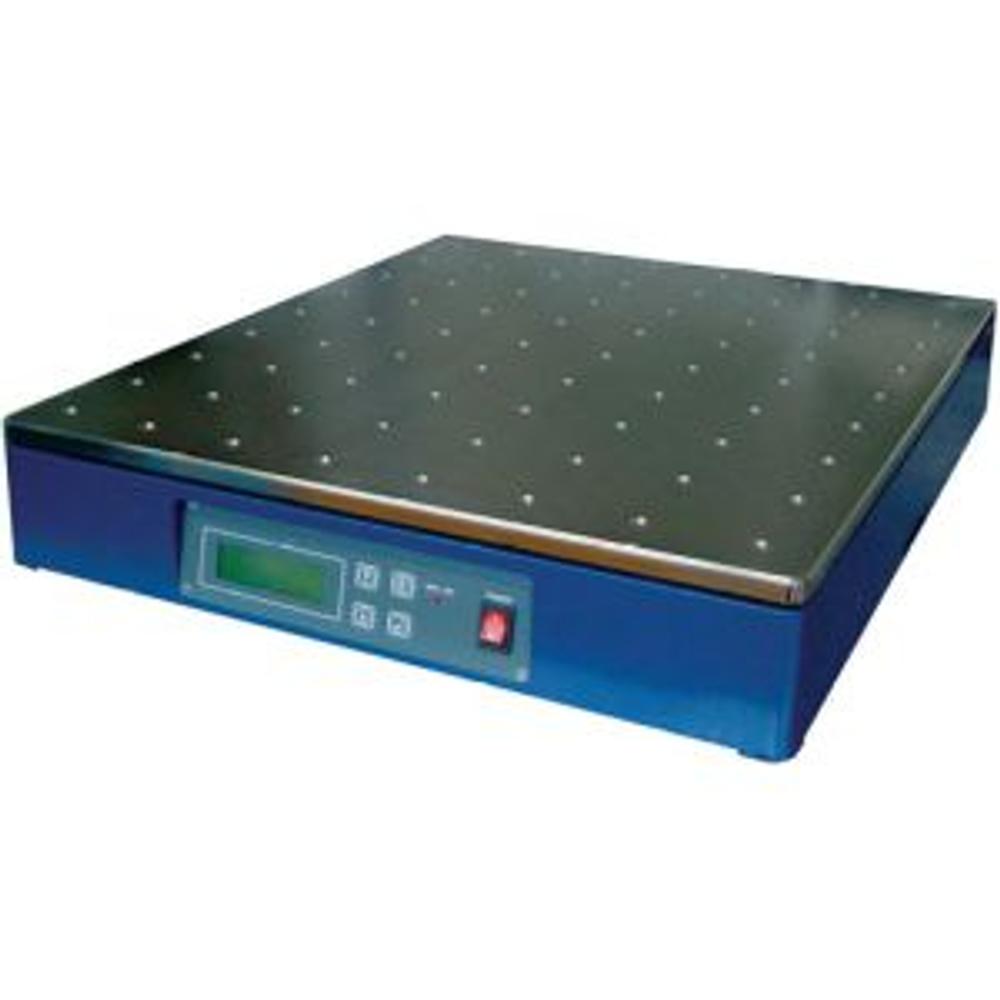
• The isolation of the 770-5060 begins at 0.7 Hz, increasing rapidly to 40 dB beyond 10 Hz; • The lack of any low frequency resonance means much better performance than with common passive damping approaches; • The… Read more →
Listed in
Order
| SKU | Description | |
|---|---|---|
| 770-5060 | solid board without holes |
Out of stock
—
|
| 770-5060 AL | with aluminium breadboard 715-5060 |
Out of stock
—
|
| 770-5060 B | with breadboard 725-5060 |
Out of stock
—
|
Specifications
| Isolation | Dynamic 0.7 Hz to 200 Hz, mainly passive at a higher frequencies although for good stability the feedback is active at least 2 kHz. |
| Transmissibility | See Transmissibility Curve. Above 10 Hz transmissibility <0.01 (-40 dB) |
| Maximum load | 140 kg |
| Dimensions | 500x600x80 mm |
| Self-weight | 23 kg |
| Electrical | |
| Safety Class | 1 |
| Power Consumption | Maximum 10 W when isolating, maximum 20 W during load adjustment |
| Input Voltage | 90-120 V AC, 47-63 Hz / 200-240 V AC, 47-63 Hz |
| Fuses | 2x1.6 A / 250 V slow, located in the power socket on the rear side of the unit |
| Normal Enviromental Conditions | |
| Protection Class | IP 20 |
| Temperature Range | 5-40° C |
| Relative Humidity | 10-90% (5-30° C) / 10-60% (30-40° C) |
| Application | Indoor |
| Altitude | Up to 2000 m (6 500 ft) |
Description
- The isolation of the 770-5060 begins at 0.7 Hz, increasing rapidly to 40 dB beyond 10 Hz;
- The lack of any low frequency resonance means much better performance than with common passive damping approaches;
- The inherent stiffness of the 770-5090 imparts excellent directional + positional stability;
The outstanding isolation performance of the 770-5060 includes all six translational and rotational vibration modes. Active isolation systems offer a solution, which combines stiffness with a very short settling time. The most useful active systems employ inertial velocity in a feedback loop. (Inertial velocity can be measured for example by integration the signal from an accelerometer). A signal proportional to inertial velocity is very similar to a viscous damping force, but with the very important difference that the dumping is relative to an internal plane. So in contrast to the passive system, by increasing the damping, the system becomes "glued" to the inertial plane which by definition means the system is isolated from the enviroment.